

If a supplier quotes 90 or 180 days, ask what was left at the end. A bag that tears when lifted and a bag whose material has undergone measurable microbial conversion have reached different endpoints.
Those figures are examples of claims a buyer might encounter. LUXOBAGS has no test report establishing a decomposition time for its bags.
Where did the test take place?
| Environment | Evidence to look for | What not to infer |
|---|---|---|
| Industrial composting | A relevant finished-product record and test conditions | The same result in a home compost heap |
| Home composting | Specific home-composting evidence and product instructions | Suitability based only on an industrial claim |
| Soil or water | Evidence for that particular environment | A composting result applies after littering |
| Landfill | Evidence for the claimed landfill conditions and endpoint | A bag will meet a composting timetable in mixed waste |
TÜV AUSTRIA’s OK compost INDUSTRIAL scheme expressly limits its assessment to industrial composting. It does not establish home, soil or water biodegradation.
What one three-year bag study actually found
In a 2019 study by Imogen Napper and Richard Thompson, selected carrier-bag materials were exposed to open air, soil and seawater. A compostable bag disappeared from the marine test setup within three months, while that bag type remained in soil after 27 months and could no longer carry a load without tearing. The tested materials fragmented in open air after nine months.
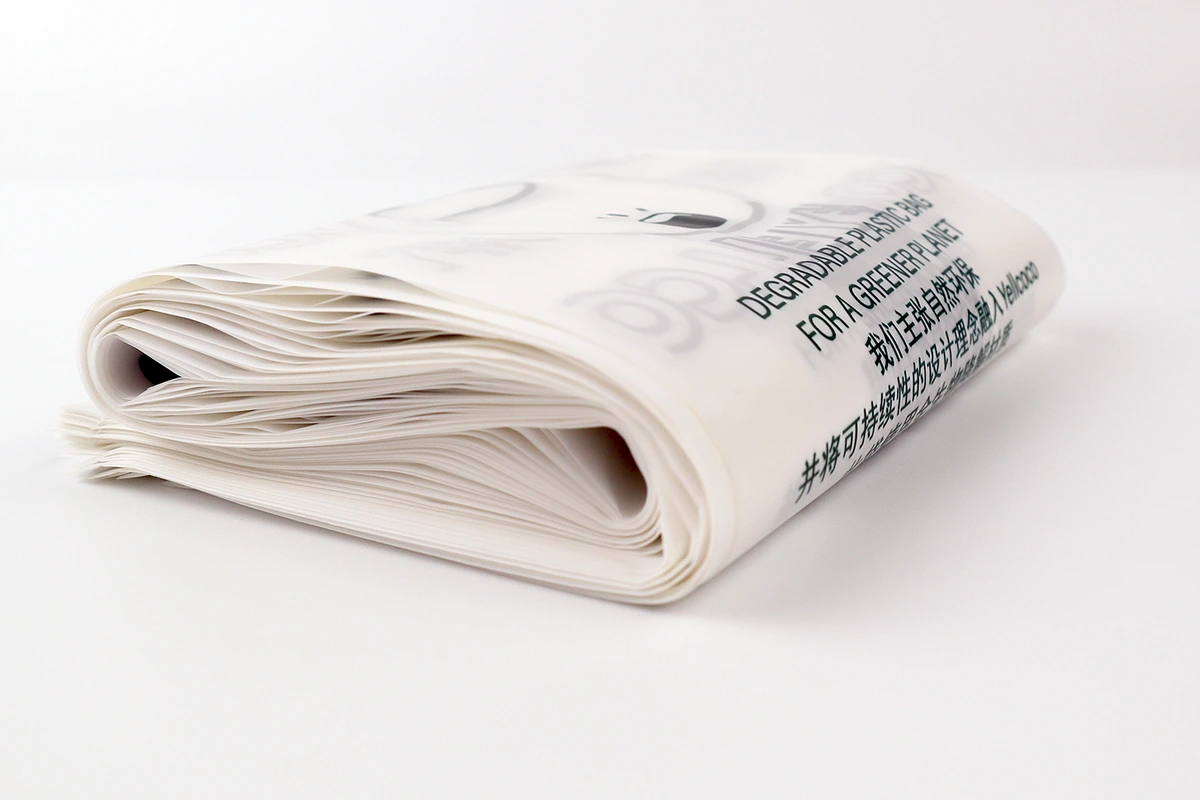
Disappearance from the marine setup was a visible observation. It did not establish complete biodegradation. The researchers studied selected carrier bags in those particular settings, so the figures cannot predict how a different bag will behave in an industrial composting facility.
Ask what “broken down” means in the report
A bag can lose strength, split into fragments or undergo microbial conversion. Those are different observations. The TÜV scheme distinguishes physical disintegration from biodegradation.
- Loss of strength: the bag no longer performs as it did before exposure.
- Disintegration: the material has physically broken into smaller pieces under the assessment conditions.
- Biodegradation: the report assesses microbial conversion, using its stated method and endpoint.
If all you have is a photograph of small fragments, you can describe what was visible. For a biodegradation figure, ask for the measurement reported by the laboratory.
What to ask about a claim in days
Ask for the report page that identifies the specimen, the test method, the conditions, the elapsed time and the result. You should be able to find each part of the supplier’s claim on that page or in the supporting test data.
Read the specimen description. Was it the finished printed bag, a sheet of film or an ingredient? Check whether the report covers the thickness and formulation you would order.
Keep “under industrial composting conditions” in any wording based on an industrial result. Removing the condition can turn a limited finding into a promise about what happens outdoors.
Match the evidence to the way the bag will be used
Write down where the customer is expected to dispose of the bag, then compare that setting with the one in the report.
- Is the product covered by the document the same as the one being quoted?
- Does the documented environment match the proposed disposal route?
- Does the receiving service accept the bag and its contents?
- Does the printed wording preserve the report’s conditions?
Before naming a collection bin, ask the local operator whether it takes the bag. The disposal-route guide lists questions to ask about the film, contents and attachments.
Read beyond the photograph and headline
Ask for the complete report if the supplier sends a cropped chart. Read the specimen description and methods alongside the result. If the document leaves the test conditions unclear, ask the issuer.

The University of Plymouth’s explanation of the 2019 research describes the strength and appearance changes observed in that experiment. Read it alongside the paper for context on those observations.
When the report does not support a timetable
Leave a fixed number of days off the artwork unless the report covers the product and the intended claim. If your order requires a particular test, send us the requirement before sampling.
Details to quote from a test report
- The exact product or material specimen assessed.
- The environment and method used in the assessment.
- The measured result, rather than an undefined “disappearance.”
- The limits on applying that result to other products or settings.
Questions about bag decomposition times
Check the claim and the disposal route
- Find the appropriate disposal route
- Check product evidence when choosing a supplier
- Read the material terminology guide
If your label needs a time claim, send the proposed wording, the bag specification and the market where it will appear. Include the test your buyer requires.
Share Your Packaging Brief