

If two suppliers both write “50 µm” on a quote, ask where they placed the gauge. One may have measured a single sheet of film, the other a bag lying flat with both walls together.
Thickness is only part of a bag specification. To judge strength for your order, put the garment, parcel or bin contents into a finished sample and see where it catches, stretches or leaks.
Microns, mils and millimeters: the conversion
A micron is one micrometer, written µm. Use mils × 25.4 = microns and microns ÷ 25.4 = mils. For millimeters, divide microns by 1,000. These conversions follow the definitions in the NIST conversion tables.
| Microns (µm) | Millimeters (mm) | Mils, rounded |
|---|---|---|
| 25 | 0.025 | 0.98 |
| 30 | 0.030 | 1.18 |
| 40 | 0.040 | 1.57 |
| 50 | 0.050 | 1.97 |
| 75 | 0.075 | 2.95 |
| 100 | 0.100 | 3.94 |
Two mils is exactly 50.8 µm. A supplier may round it to 50 µm for display. Agree which number the factory will use as its target.
State whether the thickness covers one wall or both
A flat bag puts the front and back walls together. A reading through that stack covers both walls. Move away from a folded gusset or a seam unless those extra layers are what you intend to measure.

Two ideal 30 µm layers add up to 60 µm. Before dividing a reading by two, open the bag and check how many layers were under the instrument.
Richmond Plastics’ measurement guide gives film thickness for a single wall. We quote both bag walls combined. Put the unit and wall count beside each price before comparing our figures with another supplier’s.
Find the failure before choosing a thicker film
Mark the failure on the used sample. A hole at a box corner and a split along a seal give the factory different problems to investigate.
- The item barely enters: check usable width, opening and packed-item depth before changing thickness.
- A corner punctures the film: examine the corner, internal protection and the proposed material as well as thickness.
- The bottom opens: investigate the seal and loading arrangement, not only the film wall.
- A handle tears: check handle geometry, edge condition and how the contents are carried.
If you switch from a conventional film to a biodegradable one, repeat the packing trial even if both films carry the same nominal thickness.
Compare samples with the same packing task
Give the factory a current bag and tell them where it fails. Keep its dimensions and any known material details with the replacement sample so you can repeat the same trial.
Pack the same item, use the same closure and repeat the normal handling steps with each candidate. For a mailer, include the inner packaging. For a liner, use the intended bin. For a shopping bag, test the actual load arrangement and grip.
Write what you saw. “The bottom seal opened when we lifted the bag” tells a supplier where to look on the next sample.
Agree the target and the allowed variation
Agree an acceptable range around the target, the measurement method and what happens to a delivery outside that range. A nominal thickness alone leaves those points open.
- Write the material description and thickness unit together.
- State whether the value covers one wall or both walls, and whether any coating or extra layer is included.
- Record the agreed limits and measurement method in the approved specification.
- Keep the approved sample and its specification identifiable for a repeat order.
If the quote says “gauge,” ask for the numerical value in µm or mils before comparing it.
Make thickness readings comparable
Take readings at the agreed points, using the same method and layer count. Identify readings taken at a folded edge so they are compared with the same location on the next sample.
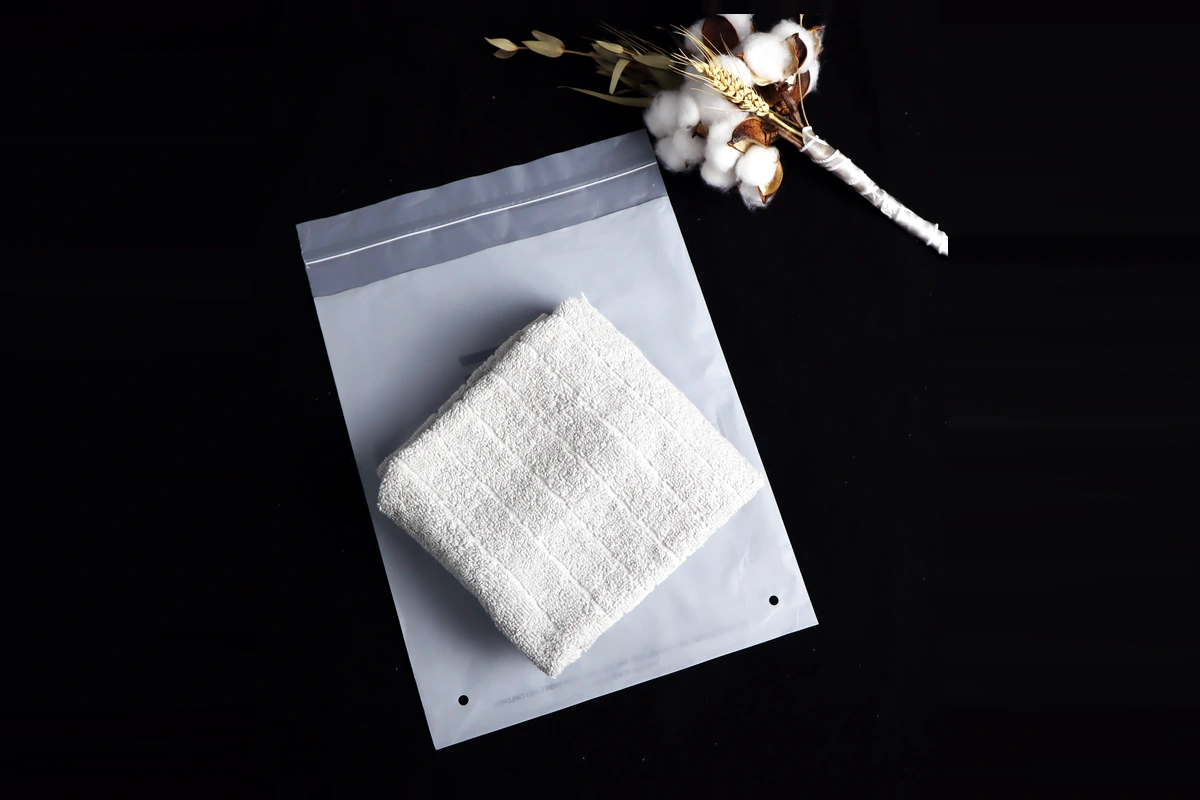
Industrial Physics discusses contact pressure, measuring surfaces and cleanliness in its guide to measuring film. When results disagree, check those conditions before treating the difference as a change in the film.
Save the reading with the instrument method and keep the packing-trial result beside it. A buyer requesting a compostability claim will also need evidence for that claim.
A thickness specification that can be checked
An example order note reads “80 µm nominal, both bag walls combined.” The note still needs the material, bag dimensions, measurement method and acceptance limits before approval. The 80 µm figure is illustrative.
Copy the approved value and wall count to the repeat-order drawing. Someone ordering the bag later should be able to tell where to take the same reading.
What belongs beside a thickness reading
- The numerical value and its unit (µm, mil or mm).
- The film measured and how many walls were under the gauge.
- The target, acceptance limits and measurement location.
- The sample reference and result when packed with the intended contents.
Questions about bag thickness
Turn the thickness decision into a sample
- Compare the custom bag formats
- Review existing and custom sample options
- Put the agreed specification into a quote request
If you need a different film, send the failed sample or a photo showing where it gave way. Include the bag dimensions and the load you used.
Discuss a Film Specification